Scam comments, pressure tactics and fake shops
Baitfree has hidden scam ads since the first version. Scams have other places to hide, though: the comments under a video, the badges on a product page, and the shop itself.
Scam comments under videos
“She is legit! I got my first payout yesterday, contact Mrs. Sandra on WhatsApp.” Replies like this sit under every finance video, posted by accounts that exist only to post them. Keyword blocklists catch some and miss the rest, because the wording changes every week.
Baitfree now judges each comment together with the name of its author — the handles of these accounts often give them away — and asks what the comment does, not which words it uses. In testing, both kinds of fake testimonial (“my broker”, “contact her on Telegram”) were hidden, and the ordinary comments around them were not.
Pressure tactics in shops
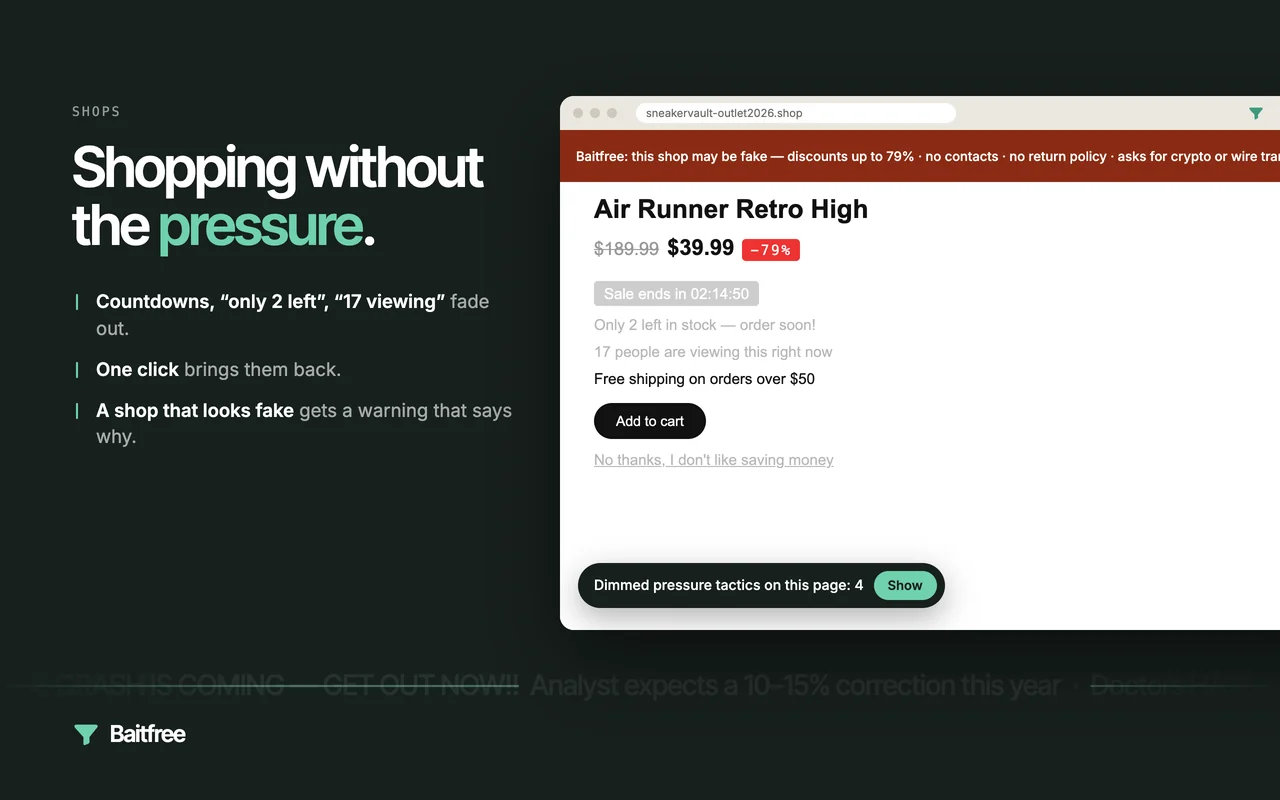
On a product page, Baitfree looks for the short texts that are there to rush you:
- Time pressure — “Sale ends in 02:14:59”, “Today only”, “Hurry!”
- Scarcity — “Only 2 left in stock”, “Almost gone”, “Selling fast”
- Crowd pressure — “17 people are viewing this”, “Someone in Berlin just bought this”
- Guilt-trip opt-outs — “No thanks, I don’t like saving money”
They are dimmed, not removed: you can still read them, they just stop shouting. A pill in the corner counts them and brings them back with one click. Prices, discounts, shipping, returns and reviews are left alone. Digits are masked before a text is judged, so a ticking countdown is judged once rather than every second. On a set of twenty such texts in English and Russian, every one was put in the right group.
Shops that look fake
Fake shops copy real brands, take payment and send nothing, or send a counterfeit. Their pages share a few habits: discounts of 70–90%, no address or phone number, no returns policy, and a request to pay by crypto or bank transfer. Baitfree checks a shop page for these signs first, on its own. Only when it finds two or more does it ask the AI model to weigh the whole picture — the shop’s address, its title, the largest discount, what contact details and policies it shows, how it wants to be paid.
If the shop looks fake, a bar at the top of the page says so and lists what was found: discounts up to 79% · no contacts · no return policy · asks for crypto or wire transfer. You can dismiss it, and it will not come back for that shop. In testing, a made-up “outlet” selling a famous brand at 79% off was flagged with high confidence, while a large outdoor retailer and a small ceramics studio with a real address were not. Well-known shops and marketplaces are never checked at all.
What leaves your browser
On shop pages: the short texts above, with their digits masked. And, only for a shop that shows several warning signs, a short summary of it, including its web address — once per shop. Both have their own switches in the settings. The details are in the privacy policy.
Baitfree is free during early access. Install it, read exactly what it sends, agree, and it starts working — no account, no card, no API keys.
Add to Chrome — free